The Beeline Project – Spring 2026

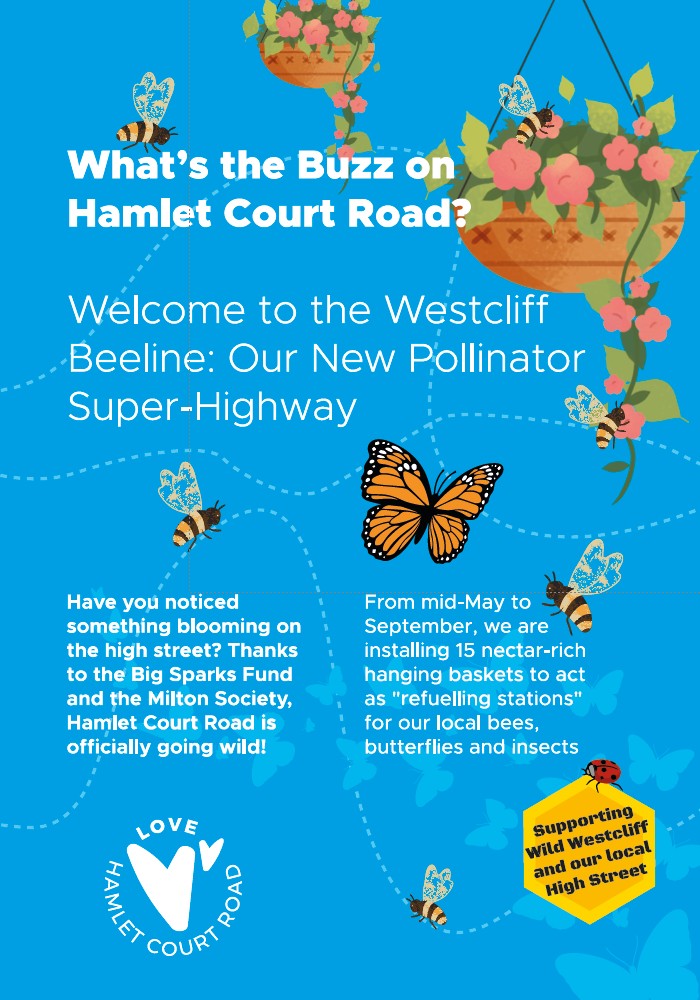
The Beeline Project is an exciting new project to create an insect super-highway in Hamlet Court Road – our local high street. With the help of Southend Council’s Big Sparks project funding, we will be bringing 15 large hanging baskets, packed with nectar rich plants as feeding stations for bees, butterflies and other flying insects. These should be in place from mid May until mid September.

Our countryside is changing with, today, far more awareness of the importance of a balanced environment but still the widespread use of pesticides and loss of habitat creates real challenges for insect life. And of course it’s no better in town with endless expances of brick, concrete and tarmac. This has contributed to a 20% decline of butterflies since the 1970s.

The Beeline will include a range of nectar rich plants including the following:

Antirrhinum majus

Calundula

Californian Poppy

Chives

Lesser catmint

Petunia

Verbena

Mini petunia

Sweet Alyssum

Diascia

Trailing Lobelia

Poached Egg Plant

You too can help support insect life by placing plants on door steps and window sills or placing a bug hotel, made from bundled sticks and twigs, in a quiet corner somewhere. If you have a garden consider leaving part of it wild and placing a small dish of water where insects can take a drink.

The Beeline will help create an environment to support insect life supporting Wild Westcliff.

We give thanks again to the Big Sparks funding from Southend City Council, funding support from Hamlet Court Calling and the installation and maintenance work by Southend Council Parks Department.

SAVE OUR CLIFFS!

Cliff Gardens
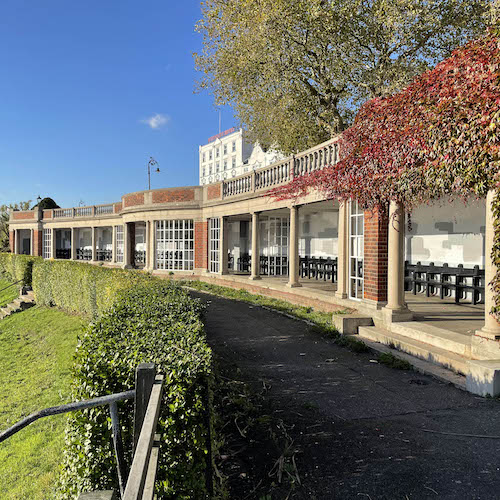
Southend Cliff Gardens sun shelter

The problem

The cliff gardens in Southend have been under threat for some time. Persistent, slow ground movement has caused cracking to footpaths and displacement to steps with little or no repairs by our Council. In fact, the Council have taken to placing barricades across pathways, preventing access. These have become more and more apparent over recent years and almost no remedial works have taken place.

In 2002 the major landslip at the bandstand showed what can happen and this dramatically reshaped part of the gardens. The bandstand and adjacent shelters were lost. Major, land retention remedial works were undertaken but the gardens below left, ever since, as roughly formed ground. Today it is allowed to grow wild with no serious attempt at managed biodiversity.

Slippage may be the constant background issue but the general lack of maintenance is very evident throughout the gardens. A basic level of maintenance can be seen at the most visible parts at the top and bottom of the cliffs and towards the west, but elsewhere maintenance is minimal or non-existent. Vermin are very evident and rough sleeping is a problem. Littering is another issue not always best managed.

What our Southend City Council can do about it

We want our Council to act to SAVE OUR CLIFFS and this should include recognising their importance at the centre of Southend’s seafront and protecting the gardens (for example by Conservation Area designation that could assist with funding bids and as used by other towns to help protect their important green spaces), improving short term maintenance and determining a long-term management strategy. This should include repairs and the removal of the barricades, allowing full public access across all of the gardens, that should then be well managed and well maintained.

This way we can all, residents and visitors alike, enjoy all of the gardens into the future. Without this intervention the future of the gardens could be lost and the public excluded.

What we have done

Milton Society has researched the gardens and produced a detailed history which you can read here. The gardens have an important past from the Georgian origins, when sea bathing first took off in England, through the Victorians and Edwardians who exploited the delights of perambulation and entertainment for hundreds of people in the gardens. Even political rallies took place where it was reported that thousands of people attended. Later, in the inter-war years, the gardens were expanded and modern sun shelters were constructed. A war memorial by Edwin Lutyens was formed. The Floral Hall entertainment venue within the gardens suffered a catastrophic fire but the popularity of the venue became the inspiration for the Cliffs Pavilion regional theatre, that we see today.

The gardens still retain a great beauty despite the maintenance problems but they need public help.

What we can do

Please sign-up at Change.org/p/save-our-cliffs to support this approach and help to SAVE OUR CLIFFS!